
Cats are talented actors. They can knock a glass off the counter, stare directly into your eyes as it falls, and then walk away as if gravity was entirely responsible. Unfortunately, they can also be remarkably good at hiding when something is wrong.
That is why it can be confusing when your cat appears completely normal – walking around the house, grooming, looking out the window, asking for attention, and possibly judging your life choices – but suddenly stops eating.
A cat that seems fine but refuses food may simply be dealing with temporary stress or a dislike of its dinner. However, loss of appetite can also be an early sign of a medical problem, sometimes before more obvious symptoms appear. A sustained decrease in appetite should therefore be taken seriously rather than dismissed as ordinary feline pickiness.
Why Would a Cat Stop Eating but Still Act Normal?
Cats instinctively hide weakness. In nature, showing signs of illness can make an animal vulnerable, and domestic cats have retained some of this behaviour. As a result, a cat may continue behaving normally during the early stages of a health problem.
You might still see your cat jumping onto furniture, grooming, following you around, or sleeping in the usual favourite spot. Meanwhile, something may be making eating uncomfortable or simply reducing the desire for food.
The important question is not only, “Is my cat behaving normally?” but also, “Has anything changed?”
Appetite itself is an important health indicator. Even when everything else appears normal, suddenly eating significantly less than usual deserves attention.
Your Cat May Simply Dislike the Food
Before imagining every possible feline disease known to veterinary medicine, consider one of the most obvious possibilities: your cat may have decided that today’s menu is unacceptable.
Cats can be surprisingly particular about food. A change in flavour, texture, smell, temperature, or brand may result in rejection. Even buying the same recipe after the manufacturer slightly changes its formulation can occasionally inspire a dramatic feline hunger strike.
Some cats also develop strong preferences for particular foods. Cornell University’s Feline Health Center notes that cats can become selective about what they are willing to eat.
Think about whether anything recently changed:
- You introduced a new food, flavour, or brand
- The food has been sitting out longer than usual
- You changed the location of the food bowl
- Another pet has started approaching your cat during meals
- The bowl is dirty or has a strong detergent smell
- Your cat recently received more treats than usual
- The food is unusually cold, dry, or stale
Sometimes solving the mystery really is that simple. Unfortunately, it isn’t always.
Stress Can Affect a Cat’s Appetite
Cats generally appreciate routine. From their perspective, breakfast should happen at the correct time, furniture should remain where management originally approved it, and unexpected visitors should preferably submit written notice several business days in advance.
Changes in the environment can affect appetite even when your cat does not appear obviously distressed.
Moving, renovations, travelling, introducing another animal, having visitors, changing feeding locations, or even changing your daily schedule can contribute to stress. Cornell’s Feline Health Center notes that psychological factors and environmental changes can contribute to food avoidance in cats.
A stressed cat might otherwise behave relatively normally, making the connection difficult to notice.
Dental Problems Can Make Eating Uncomfortable
One particularly important possibility is dental pain.
Your cat may genuinely want to eat but find chewing uncomfortable. Dental disease, inflammation, damaged teeth, oral infections, or other problems affecting the mouth can interfere with eating. Veterinary sources identify oral and dental disease among common medical reasons pets have difficulty eating.
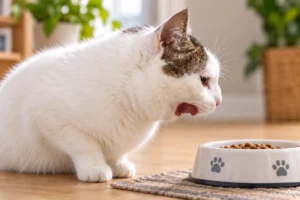
Watch what happens when your cat approaches food. A cat experiencing oral discomfort may smell the food, appear interested, take a bite, and then walk away. Some cats begin preferring softer food or chewing differently.
Because problems inside a cat’s mouth can be difficult to evaluate properly at home, this is a good example of why a veterinary examination can be far more useful than repeatedly switching foods and hoping something works.
Nausea Does Not Always Mean Vomiting
People often assume that a nauseous cat will vomit.
Not necessarily.
Cats can experience nausea without actually vomiting. A mildly nauseous cat may still walk around normally while showing little interest in eating.
Possible gastrointestinal or systemic conditions can interfere with appetite before other obvious symptoms appear. Pancreatic disease, for example, can produce vague signs in cats, including reduced appetite.
You may occasionally notice your cat approaching food, sniffing it enthusiastically and then suddenly backing away. That strange little interaction can sometimes indicate that the cat wants to eat but feels uncomfortable doing so.
Could There Be an Underlying Medical Condition?
Loss of appetite is not a disease itself. It is a symptom that can accompany many different conditions.
Kidney disease, liver problems, gastrointestinal disorders, infections, pancreatitis, dental disease, pain, and other medical issues may influence appetite. Cornell specifically identifies appetite loss as a clinical sign associated with numerous feline health conditions.
This does not mean that a cat skipping breakfast automatically has a serious illness. It means persistent appetite changes should not be diagnosed based on behaviour alone.
A veterinarian can examine your cat and, when appropriate, recommend diagnostic testing to determine whether something more significant is happening.
Why Not Eating Can Become a Bigger Problem for Cats
Cats should not go prolonged periods without adequate nutrition.
One particular concern is hepatic lipidosis, sometimes called fatty liver disease. This condition is strongly associated with significant food avoidance and can become serious. Cornell notes that hepatic lipidosis is commonly preceded or accompanied by anorexia.
This is one reason the “I’ll just wait several days and see what happens” strategy isn’t ideal.
Even if your cat appears happy, alert, and perfectly capable of sprinting across the house at 3:17 a.m. for mysterious reasons, a continuing refusal to eat deserves veterinary attention.
What Should You Watch for at Home?
A little observation can provide your veterinarian with extremely useful information. Instead of simply reporting that your cat “isn’t eating,” pay attention to patterns and changes.
Keep an eye out for:
- Complete refusal of food versus simply eating less
- Drinking substantially more or less than usual
- Vomiting, diarrhea, constipation, or changes in litter box habits
- Drooling, bad breath, pawing at the mouth, or difficulty chewing
- Weight loss
- Hiding or sleeping more than usual
- Changes in grooming
- Unusual vocalization
- Changes in urination
- Interest in food followed by suddenly walking away
You do not need to conduct your own diagnostic investigation worthy of a veterinary detective series. Simply noticing these details can make the professional evaluation much more informative.
Should You Try to Encourage Your Cat to Eat?
If your cat skips part of one meal but otherwise seems healthy, you can check whether the food is fresh, ensure the feeding area is quiet, and see whether your cat shows interest in its usual food.
What you should avoid is turning your kitchen into an experimental pharmacy.
Human medications, supplements, appetite stimulants, or improvised treatments should not be given without veterinary guidance. Appetite stimulants used in cats are medications that veterinarians may prescribe in appropriate situations, but the underlying reason for the appetite loss still matters.
Encouraging eating is useful only when it is safe and appropriate for the individual cat.
When Should You Contact a Veterinarian?
If your cat continues refusing food, is eating dramatically less than normal, appears uncomfortable while eating, or develops additional symptoms, getting veterinary advice promptly is the safer approach.
The urgency can depend on your cat’s age, medical history, medications, current health conditions, and how much food has actually been consumed. Young kittens, older cats, cats with chronic medical conditions, and cats receiving medications may require particularly careful assessment.
When something seems unusual, an experienced team at an animal clinic in Calgary can evaluate the entire picture rather than focusing on appetite alone.
At Westspringsvet, a veterinary examination can help determine whether your cat is simply being exceptionally selective about dinner or whether there is an underlying problem requiring treatment.
What Can a Veterinarian Check?
A veterinary appointment usually provides far more information than you can obtain by observing your cat at home.
The veterinarian can evaluate your cat’s general condition, hydration, mouth and teeth, abdomen, weight, temperature, and other physical findings. Depending on those findings and your cat’s history, additional diagnostics such as bloodwork, urine testing, imaging, or other tests may be recommended.
The goal is not simply to convince your cat to eat something. It is to understand why the appetite changed in the first place.
That distinction matters.
Switching flavours might temporarily solve a food preference problem. It will not solve dental pain, nausea, kidney disease, or another medical condition.
The Bottom Line
If you’re wondering, “Why is my cat acting normal but not eating?” the answer can range from ordinary pickiness or temporary stress to a medical condition that simply has not produced obvious symptoms yet.
Cats are famously subtle about illness. Looking normal does not always mean feeling normal.
Pay attention to how long the appetite change lasts, how much your cat is actually eating, and whether anything else has changed – even something small.
And when the refusal to eat persists or something simply seems off, professional veterinary care is the sensible next step. Your cat may strongly disagree with being placed in a carrier, of course. That particular disagreement is also completely normal.