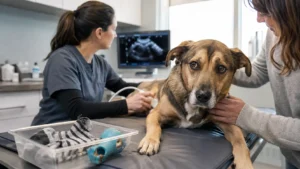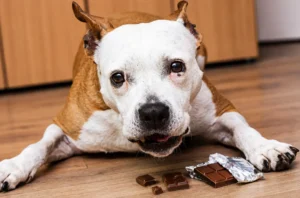

You walk into the kitchen and notice something suspicious: an empty chocolate wrapper on the floor, a very satisfied dog nearby, and absolutely no witnesses willing to cooperate. Your dog may look perfectly fine – perhaps even proud of the operation – but chocolate ingestion can become a genuine medical emergency.
Chocolate contains theobromine and caffeine, compounds that dogs process much more slowly than humans. Depending on the type and amount of chocolate eaten, your dog’s size, and other health factors, chocolate poisoning can affect the digestive system, heart, and nervous system.
So, what should you actually do after your dog eats chocolate? The most important rule is simple: act quickly rather than waiting for symptoms to appear.
First, Find Out What Your Dog Ate
Before throwing every chocolate product in the house into the garbage in a moment of panic, collect some basic information. Your veterinarian will use it to estimate how serious the exposure may be.
Try to determine:
- What type of chocolate your dog ate
- Approximately how much was consumed
- Your dog’s approximate weight
- When the chocolate was eaten
- Whether the product contained additional ingredients such as raisins, macadamia nuts, coffee, or xylitol
If the packaging is still available, keep it. Bringing the wrapper or taking a clear photo of the ingredient list can make the veterinarian’s job much easier.
You do not need to perform complicated calculations yourself. Chocolate toxicity depends on the concentration of methylxanthines – primarily theobromine and caffeine – and those concentrations vary significantly between products. A veterinary professional can evaluate the exposure more accurately.
Not All Chocolate Is Equally Dangerous
A tiny bite of milk chocolate and a large chunk of baking chocolate are very different situations.
In general, darker and more concentrated chocolate products contain more theobromine. Cocoa powder and baking chocolate are particularly concerning, while milk chocolate usually contains less. White chocolate contains very little theobromine, although its high fat and sugar content can still cause digestive problems.
This is also why asking, “My dog ate chocolate – will he be okay?” does not have a simple yes-or-no answer.
A large dog that steals a small milk chocolate cookie may face a very different level of risk than a small dog that eats several squares of dark chocolate.
Instead of guessing, contact a vet clinic in Calgary and provide the product type, estimated amount eaten, your dog’s weight, and the approximate time of ingestion.
Call a Veterinarian Even If Your Dog Looks Normal
One of the biggest mistakes owners make is assuming that everything is fine because their dog is currently running around, wagging their tail, and requesting dinner.
Chocolate poisoning does not always cause immediate symptoms. Signs may develop several hours after ingestion, and by the time severe symptoms appear, treatment can become more complicated.
Calling a veterinary clinic early gives the veterinarian an opportunity to assess the exposure before the situation progresses.
Depending on what your dog ate and how recently it happened, the veterinarian may recommend monitoring at home, coming to the clinic promptly, or seeking emergency care.
Early professional advice can sometimes turn a potentially serious poisoning into a much more manageable situation.
Do Not Automatically Make Your Dog Vomit at Home
The internet contains an impressive collection of home remedies, and unfortunately, not all of them deserve a place in your dog’s medical treatment plan.
You may encounter instructions suggesting that you immediately induce vomiting. Do not do this unless a veterinary professional specifically tells you to.
Whether vomiting is appropriate depends on several factors, including how much time has passed, what was eaten, whether your dog is already showing symptoms, and the dog’s overall condition.
Trying to induce vomiting incorrectly can cause additional complications.
A veterinarian can determine whether decontamination is appropriate and perform or recommend it safely.
Watch for Signs of Chocolate Poisoning
Symptoms vary according to the dose and the individual dog. Mild poisoning may begin with gastrointestinal problems, while larger exposures can affect the heart and nervous system.
Watch carefully for:
- Vomiting or diarrhea
- Increased thirst or urination
- Restlessness, agitation, or unusual hyperactivity
- Heavy panting or rapid breathing
- A fast or irregular heartbeat
- Muscle tremors
- Weakness or poor coordination
- Seizures or collapse
Clinical signs commonly develop within several hours after ingestion. Some dogs may initially appear completely normal.
If your dog develops severe restlessness, tremors, seizures, collapse, breathing difficulties, or significant changes in heart rate, the situation should be treated as urgent. A Calgary emergency vet hospital may be the appropriate destination when immediate veterinary treatment is required.
What Will the Veterinarian Do?
Veterinary treatment depends largely on how much chocolate was eaten, what type it was, how long ago the ingestion occurred, and whether symptoms have already developed.
If the dog arrives soon after eating chocolate and is still clinically stable, the veterinary team may attempt to reduce absorption of the toxic compounds.
In other cases, treatment may focus on controlling symptoms and supporting the body while the toxins are eliminated.
Veterinary care can include medications, intravenous fluids, monitoring of heart rhythm and body temperature, treatment for tremors or seizures, and other supportive measures when necessary.
This is where professional evaluation matters. Two dogs that ate what appears to be the same amount of chocolate can require very different treatment depending on their weight, health, and the exact product involved.
Why Waiting for Symptoms Can Be Risky
It is tempting to think, “I’ll just watch him for a few hours.”
Sometimes the exposure turns out to be minor. The problem is that you cannot reliably determine that simply by watching your dog immediately after the incident.
Theobromine stimulates both the cardiovascular and central nervous systems. At higher doses, chocolate poisoning can cause dangerous heart rhythm abnormalities, severe agitation, tremors, and seizures.
The earlier the exposure is evaluated, the more options veterinarians may have to limit absorption and reduce the risk of complications.
Think of it like discovering water leaking under your kitchen sink. You could wait until the ceiling downstairs becomes a waterfall, but dealing with the problem early usually makes considerably more sense.
Remember That Chocolate Desserts May Contain Other Hazards
Sometimes chocolate itself is only part of the problem.
Brownies, cookies, protein bars, candies, and baked goods can contain ingredients that create additional risks for dogs. Raisins and macadamia nuts, for example, can be toxic. Sugar-free products may contain xylitol, which can be extremely dangerous to dogs even in relatively small amounts.
Coffee-flavoured desserts may also increase caffeine exposure.
For this reason, telling your veterinarian only that your dog ate “a cookie” may not provide enough information. Check the complete ingredient list whenever possible.
How to Prevent the Next Chocolate Heist
Dogs are remarkably talented at finding food that humans believed was “completely out of reach.”
A box placed near the back of a countertop may look secure to you. To a determined Labrador, it may simply represent an interesting engineering challenge.
Store chocolate, baking ingredients, candy, and desserts inside closed cupboards or containers your dog cannot access. During holidays, remind guests and children not to leave chocolate boxes, gift bags, or desserts where pets can reach them.
Also remember that dogs can investigate handbags, backpacks, grocery bags, and wrapped gifts.
The safest chocolate for your dog is the chocolate they never manage to steal.
When in Doubt, Let a Veterinary Team Assess the Risk
Chocolate ingestion does not automatically mean your dog will become seriously ill, but it is never something that should simply be ignored.
The risk depends on the type of chocolate, quantity eaten, your dog’s body weight, additional ingredients, and the amount of time that has passed. A professional assessment can quickly help determine whether your dog needs treatment or careful monitoring.
At West Mount Vet, our veterinary team can evaluate your dog’s situation, assess potential toxicity, and recommend the safest next steps. When accidental chocolate ingestion happens, getting reliable veterinary guidance early is far better than experimenting with home remedies and hoping everything works out.
Contact West Mount Vet Today
Did your dog just raid the chocolate stash? Contact West Mount Vet as soon as possible – 403-283-3354. Tell our team what your dog ate, approximately how much was consumed, your dog’s weight, and when it happened. We can help assess the risk and guide you toward the appropriate care.
Your dog may believe chocolate theft was an excellent decision. Our job is to make sure it does not turn into a dangerous one.